The five kinds of French reading question, and how to answer each
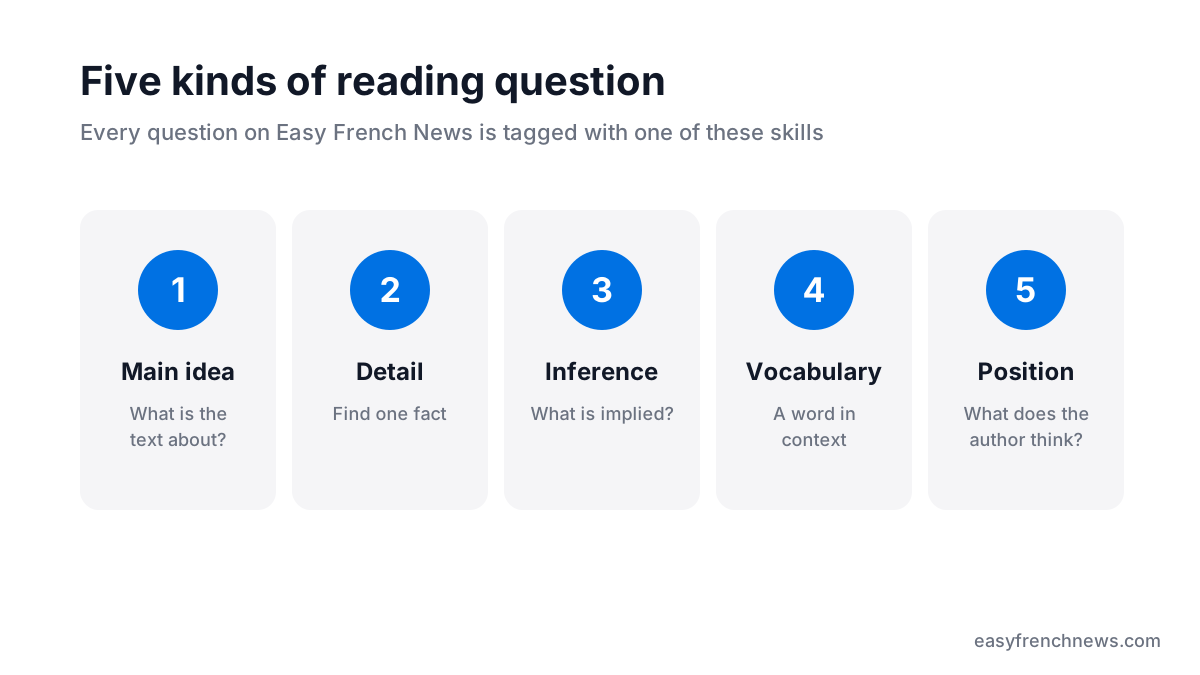
A multiple-choice reading paper looks like one long test. It's really five kinds of question asked again and again, and each kind has its own method and its own trap. On Easy French News every comprehension question is tagged with one of these five skills, and the same five run through the TEF Canada and TCF Canada reading papers. Learn to recognise them and you'll know what each question wants before you read the options.
We'll use one short example text throughout (invented for this post, not a real news story):
La ville a annoncé mardi qu'elle prolongerait les heures d'ouverture de ses bibliothèques à partir de janvier. Selon la mairie, la fréquentation a augmenté de 18 % en un an, surtout le soir. Certains élus de l'opposition jugent toutefois la mesure insuffisante : ils réclament l'ouverture le dimanche matin, « quand les familles sont disponibles ». La mairie répond que le budget de 2027 ne le permet pas, mais n'exclut pas un essai l'été prochain.
1. Main idea
What it asks: what is the text mainly about, or what is its purpose?
Method: read the whole text before the options. The main idea is usually in the first sentence of a news text and the last paragraph of an argued one. Then summarise it in your own words, and only then look for the option that matches.
The trap: an option that's true but too narrow. "Attendance has risen by 18%" is true, but it's a detail. The main idea here is that the city is extending library hours, and not everyone thinks it goes far enough.
2. Detail
What it asks: a specific fact, such as a figure, a date, a condition or who did what.
Method: read the question first, pick a keyword (when, how much, a name), then scan the text for it. You don't need to understand everything to answer a detail question.
The trap: an option that uses words from the text in the wrong combination. "Attendance rose 18% on Sunday mornings" uses three words from the text and is false. The rise was mostly in the evening, and Sunday mornings are what the opposition is asking for.
3. Inference
What it asks: something the text implies but doesn't say outright.
Method: find the sentence the inference rests on and check that the option follows from it necessarily, not just plausibly. From "n'exclut pas un essai l'été prochain" we can infer that Sunday opening is possible in the future. We can't infer that it will happen.
The trap: an option that's reasonable but goes too far. Inference questions punish common sense that isn't backed by the text.
4. Vocabulary in context
What it asks: what a word or expression means here.
Method: cover the word and read the sentence. What word would you expect there? Then pick the option that fits the sentence, not the one that matches the dictionary. In "ils réclament l'ouverture", réclament means "demand", not "complain".
The trap: the most common meaning of the word, or a false friend. Exam writers choose words whose everyday meaning is wrong in context on purpose.
5. The author's position
What it asks: what the writer thinks, or the tone of the text.
Method: separate the voices. News texts report many views (selon la mairie, les élus jugent, quotations), and the author's own view, if any, shows in word choice and structure. Watch the concession pattern: certes X, mais Y. The author stands with Y.
The trap: an option that states a view someone in the text holds. In our example the opposition finds the measure insufficient, but the text itself is neutral reporting. "The author criticises the city" would be wrong.
Practise by type, not just by test
Most candidates practise with whole papers and look at the total score. It's more useful to log your errors by type. If seven of your ten mistakes are inference and author's position, more vocabulary won't fix them; reading argued texts and separating the voices will.
On Easy French News, the reading skills profile does this for you: every answer is recorded with its skill, and after a few timed readings you'll see your accuracy for each of the five, with your weakest one highlighted. With Plus, you can then practise that skill on its own.
A quick checklist for the exam
- Identify the type before reading the options.
- Main idea and author's position: read the whole text first.
- Detail: read the question first and scan.
- Inference: is it necessarily true?
- Vocabulary: what fits this sentence?
- Always answer. A blank scores nothing.
For how these fit into a full preparation plan, see NCLC 7 in French reading. To check where you stand now, take the free reading placement.