Québec French in the news: what learners should know
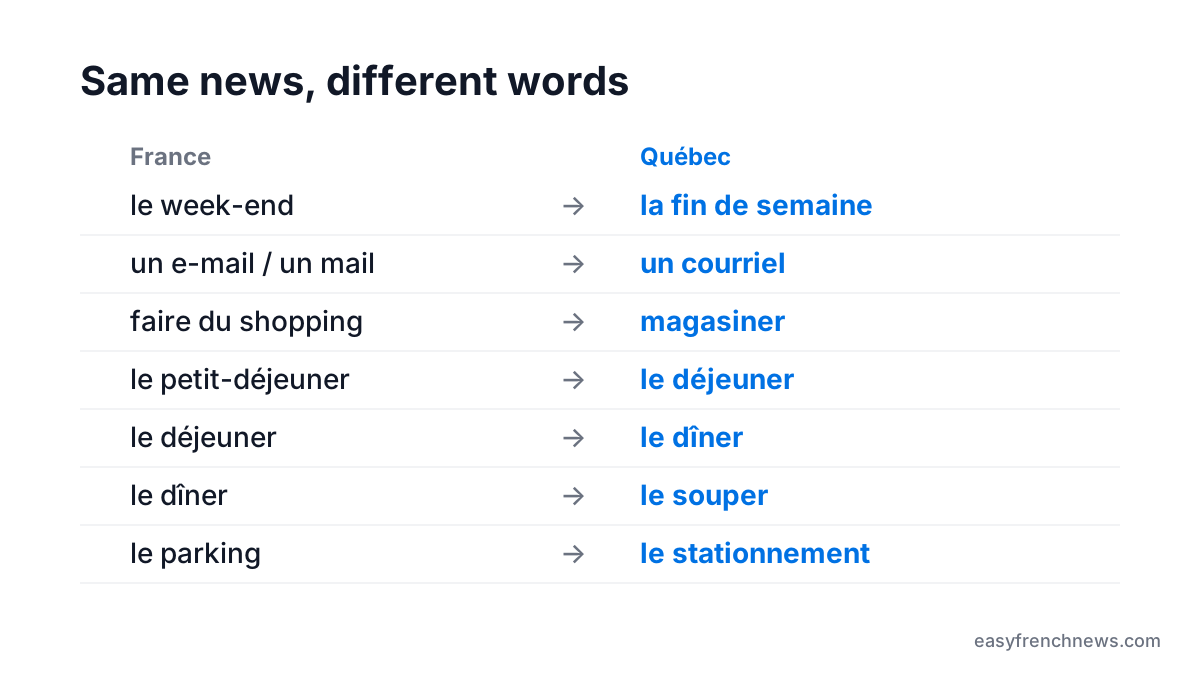
Many learners preparing to live in Canada worry that the French they're learning is "the wrong French". Should you learn Québec French? Will a newspaper in Montréal read differently from one in Paris? For written news, the answer is reassuring: it's the same language, with a recognisable vocabulary on top. Here's what actually differs, and what doesn't.
Written news is standard French
Open Radio-Canada's news site, Le Devoir or La Presse and you're reading standard written French. The grammar, the verb tenses, the sentence structure and most of the vocabulary are the same as in Le Monde. A learner who reads French news comfortably can read Québec news comfortably.
The big differences between Québec and European French are in speech: pronunciation, informal vocabulary, some grammar in casual conversation. Those matter a lot for daily life and for listening, but they rarely appear in a news article except inside quotations.
The words that do differ
Where Québec news does differ, it's mostly vocabulary, and much of it follows one pattern: Québec prefers French words where France borrows English ones. The Office québécois de la langue française promotes French terms, and the media generally use them.
| Usual in France | Usual in Québec | Meaning |
|---|---|---|
| le week-end | la fin de semaine | the weekend |
| un e-mail, un mail | un courriel | an email |
| faire du shopping | magasiner, le magasinage | to go shopping |
| le parking | le stationnement | parking |
| le chat (en ligne) | le clavardage | online chat |
| un portable | un cellulaire | a mobile phone |
| une boisson | un breuvage | a drink |
| une supérette, une épicerie de quartier | un dépanneur | a convenience store |
The meal trap
This one causes real confusion, including in news about schools and work hours:
- In France: le petit-déjeuner (breakfast), le déjeuner (lunch), le dîner (dinner).
- In Québec: le déjeuner (breakfast), le dîner (lunch), le souper (dinner).
So le dîner is lunch in Montréal and dinner in Paris. Read the context: a dîner at noon is lunch.
Institutions and everyday life
Québec news is full of words for its own institutions: the cégep (a college between secondary school and university), the Assemblée nationale (Québec's legislature), les fonctionnaires of a ministère. These aren't dialect. They're names for things, and you learn them by reading the news about them.
A myth to drop
Québec French doesn't use septante and nonante (70 and 90). Those are Belgian and Swiss. In Québec, as in France, it's soixante-dix and quatre-vingt-dix.
What this means for the TEF and TCF
TEF Canada and TCF Canada are written in standard international French. You won't be marked down for using European vocabulary, and you won't need Québec slang to understand the reading paper. If you write fin de semaine or week-end, both are correct.
For listening, it helps to hear different accents before the exam. Check the official sample tests to hear the kind of recordings used. For daily life in Québec, spoken Québec French is worth learning on its own; for the exam and for reading the news, standard French is what you need.
How to read Québec news as a learner
- Start levelled. If Québec news is too hard, it's because native news is hard, not because it's from Québec. Build up with levelled news first.
- Keep a two-column list like the table above. When you meet a Québec term, note its France equivalent, and vice versa. You'll be fine in both places.
- Read about Canada. The Reports on this site are adapted from Statistics Canada's « Le Quotidien », which is about life in Canada: housing, work, health, education. That's also exam vocabulary.
- Use the context. A dîner at noon is lunch. A courriel is something you send. Context resolves almost every regional word.
For more on preparing for Canada, see French for Canada and our guide to CEFR vs NCLC levels.