CEFR vs NCLC: what A1, A2 and B1 mean for TEF and TCF Canada
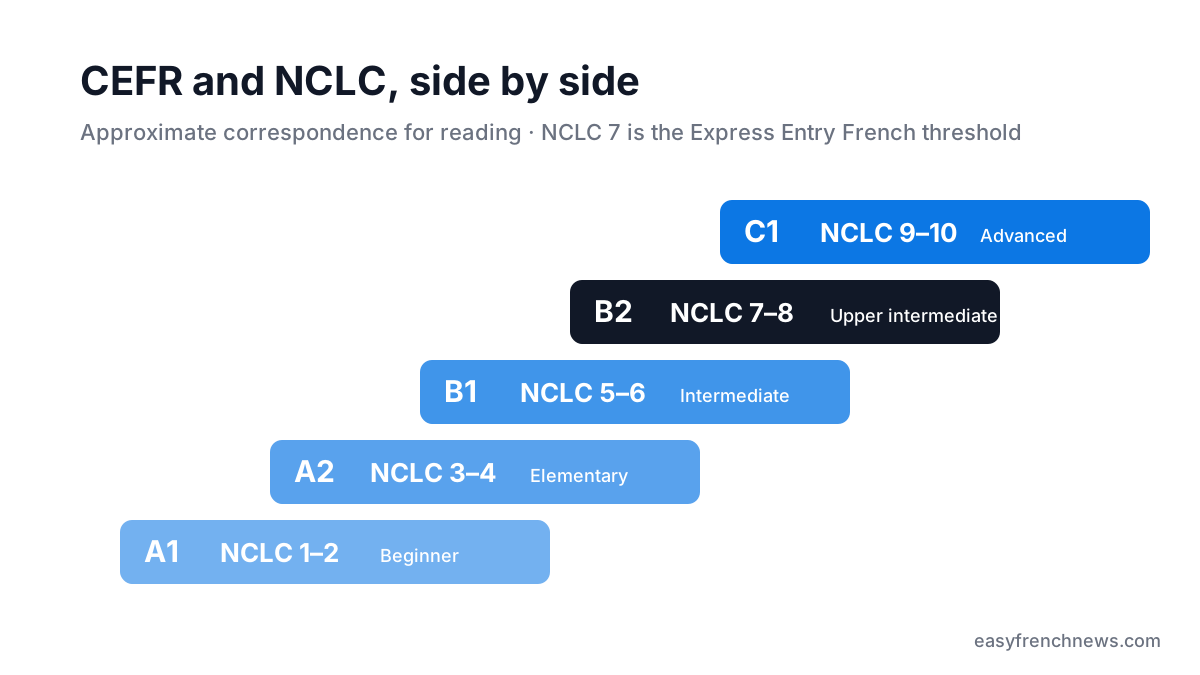
If you learned French in Europe, or in most language schools, your level is a CEFR letter: A1, B2, C1. If you're preparing French for Canadian immigration, the number that matters is an NCLC level from 1 to 12. The two scales describe the same thing in different words, and confusing them can cost you months of preparation. Here is how they fit together.
Two scales, one ability
The CEFR (Common European Framework of Reference for Languages, CECR in French) has six levels, A1 to C2. It's used by European exams such as the DELF and DALF and by most textbooks and courses.
The NCLC (Niveaux de compétence linguistique canadiens) is the French-language twin of the Canadian Language Benchmarks (CLB). It has twelve levels and is the scale Immigration, Refugees and Citizenship Canada (IRCC) uses. When you sit TEF Canada or TCF Canada, your results are converted to an NCLC level for each skill: reading, listening, writing and speaking.
| CEFR | ≈ NCLC | What a reader can do |
|---|---|---|
| A1 | 1–2 | Understand short, simple texts on familiar topics: signs, notices, very short messages. |
| A2 | 3–4 | Follow short practical texts and the main point of a simple news brief. |
| B1 | 5–6 | Understand the main ideas and key details of clear texts on familiar subjects, including straightforward news. |
| B2 | 7–8 | Read articles and reports on current issues, follow an argument and recognise the writer's position. |
| C1 | 9–10 | Read long, complex texts, including implicit meaning and nuanced opinion. |
| C2 | 11–12 | Read virtually anything with ease. |
Why NCLC 7 is the number everyone talks about
For many Canadian immigration candidates, NCLC 7 is the target, roughly the B2 band. Under Express Entry, IRCC awards additional points for strong French and runs category-based draws for French-language proficiency, and NCLC 7 in all four skills is the threshold most often quoted for both. Rules change, so check the current requirements on IRCC's Express Entry pages before you plan around them.
Two details catch people out:
- It's per skill. NCLC 7 in reading doesn't help if your writing is NCLC 6. The weakest skill decides.
- A CEFR certificate isn't an NCLC result. A DELF B2 shows you're at B2, but IRCC needs a TEF Canada or TCF Canada result, converted to NCLC with its own equivalency charts.
Québec has its own programmes and its own scale for French, so if you're applying there, check the Québec government's requirements separately.
How the levels on this site map
Every article on Easy French News carries both labels:
There's no separate B2 version, on purpose. When we measured our texts, the B1 versions already ran close to B2, one step below the original. And the original news text is the register you'll meet in the exam's later reading documents. So for NCLC 7 reading, the target is simple: read the original comfortably.
Where are you now?
Estimating your own level is hard. Most people overrate their reading and underrate their listening. Two practical options:
- Take an official sample test from the TEF or TCF test owner.
- Take our free reading placement: two short timed readings with exam-style questions that estimate your reading band on the NCLC scale. It takes about fifteen minutes and doesn't need an account. It's an estimate of reading only, not an official score.
From B1 to NCLC 7: what actually changes
Moving from NCLC 5–6 to 7 in reading is less about new words than about longer, denser texts. You need to follow an argument across a paragraph, separate fact from opinion, and do it at exam pace. We wrote a full plan in NCLC 7 in French reading: what it takes and how to get there.