What actually changes between A1 and real French news? We measured
Every story on Easy French News is published four times: an A1 brief, an A2 brief, a B1 version and the original French. But what actually changes between them? Is A1 just "the same with easier words"? We measured it, and the answer surprised us.
What we measured
We took the 37 articles published between 13 September and 10 October 2026, all four versions of each, and counted:
- length: words per text;
- sentence length: average words per sentence, and the share of sentences over 25 words;
- vocabulary: how many of the running words are among the 1,000, 2,000, 3,000 and 5,000 most frequent French words.
These are our own texts, so this describes how our levels are built, not French in general. The original texts here are French translations of Spanish science journalism (Agencia SINC) and French opinion and analysis pieces (The Conversation France). Both are typical of serious French-language news.
Finding 1: sentences change most
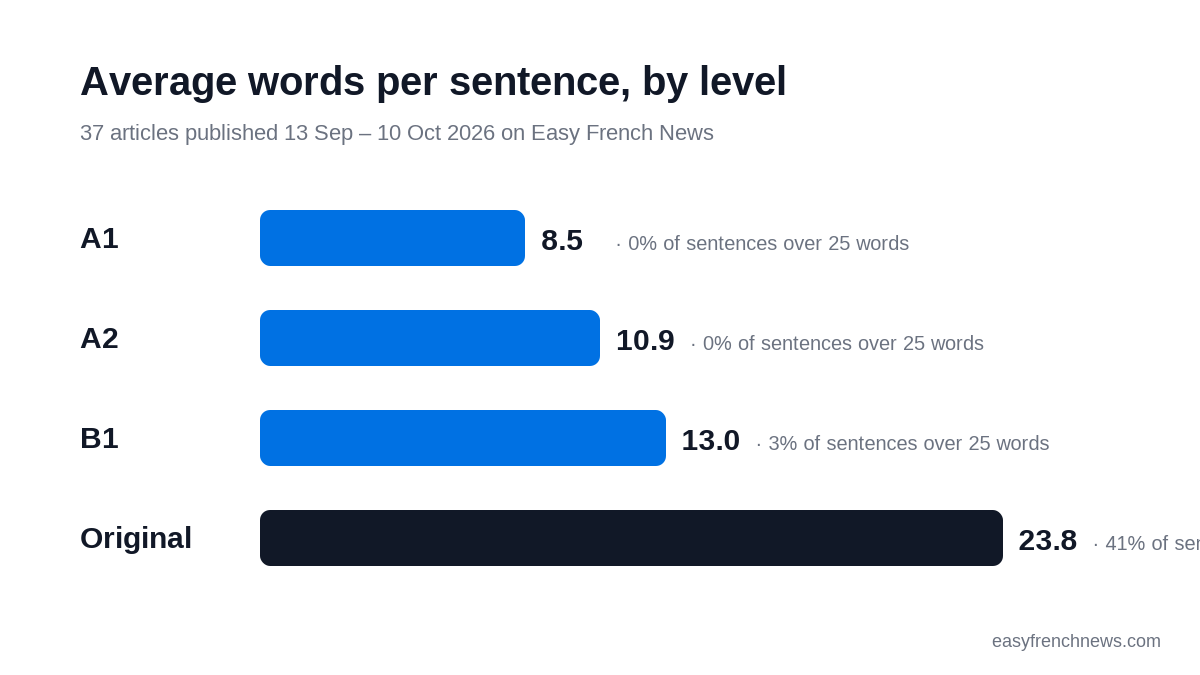
| Version | Words per sentence | Sentences over 25 words | Typical length |
|---|---|---|---|
| A1 | 8.5 | 0% | ~260 words |
| A2 | 10.9 | 0% | ~480 words |
| B1 | 13.0 | 3% | ~1,200 words |
| Original | 23.8 | 41% | ~1,150 words |
The original's average sentence is almost three times as long as the A1's, and four sentences in ten run past 25 words. In the original, a single sentence often carries a main clause, a relative clause, a date, a figure and a source. In the A1 version, each of those becomes its own sentence.
Look at the B1 column too. It's as long as the original, because it follows it paragraph by paragraph, but its sentences are just over half the length. B1 is the same information, cut into shorter pieces.
Finding 2: vocabulary changes less than you'd think
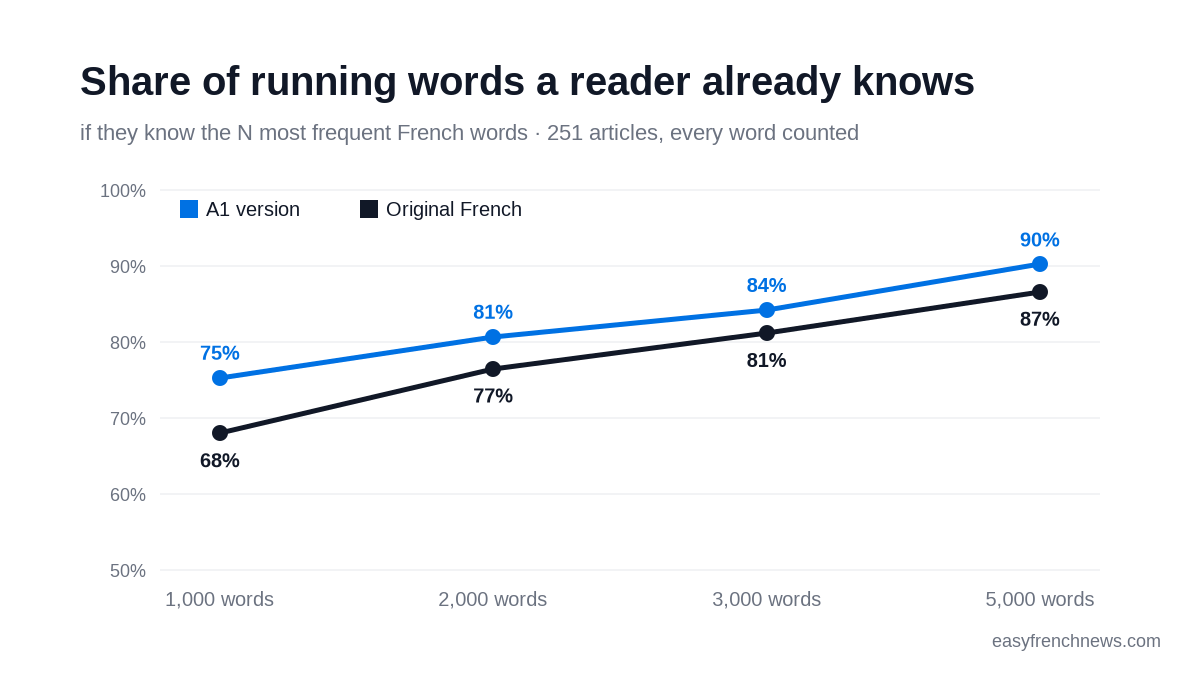
Across the whole archive, the 1,000 most frequent French words make up about 75% of the words in an A1 text and about 68% in an original. With 5,000 words, the figures are 90% and 87%. The gap is real but small: a few points, not a different language.
Why so small? Partly because news is news. A story about a heart study needs cœur, étude and chercheurs at every level. Simplifying the vocabulary too far changes the story, and we don't do that. And partly because names, numbers and technical terms (insuffisance cardiaque) can't be simplified away. They're explained instead.
A caveat: these counts include names and numbers, which no frequency list covers, so the real coverage of "ordinary" words is a little higher at every level.
Finding 3: the briefs choose; B1 keeps everything
The A1 and A2 versions are briefs. They keep the main facts in a fixed order (what happened, who, where, why it matters) and drop secondary details. That's how an A1 text stays near 260 words when the original runs past 1,000. The rule we hold them to is simple: the brief chooses what to keep, but never changes what it keeps. Every name, number and date in a brief is the source's own.
B1 doesn't choose. It keeps every paragraph, which is why it's the bridge to the original: when you move from B1 to the original, you'll meet the same information in the same order, just in longer sentences.
What this means for learners
Train for long sentences, not just new words
If vocabulary only differs by a few points, the main skill between B1 and native news is holding a long sentence in your head. Practise it directly:
- Read the B1 and then the original of the same paragraph, and find where the original joined two B1 sentences into one.
- When a sentence is long, find the main verb first, then attach everything else to it.
- Learn the connectors that make long sentences possible: alors que, tandis que, dont, ce qui, afin de, selon.
Use the briefs for volume
Short A1 and A2 texts let you read a story a day without burning out. Volume builds the core vocabulary that covers three-quarters of any text.
Move up with a known story
The most efficient step up is to reread a story you know at the next level. The words are familiar, so all your attention goes to the structure, which is exactly what changes most.
Try it
Open any article on the site and switch between A1 and the original, paragraph by paragraph. Or start from the homepage, which shows the opening of today's story at all four levels side by side.