How many French words do you need to read the news?
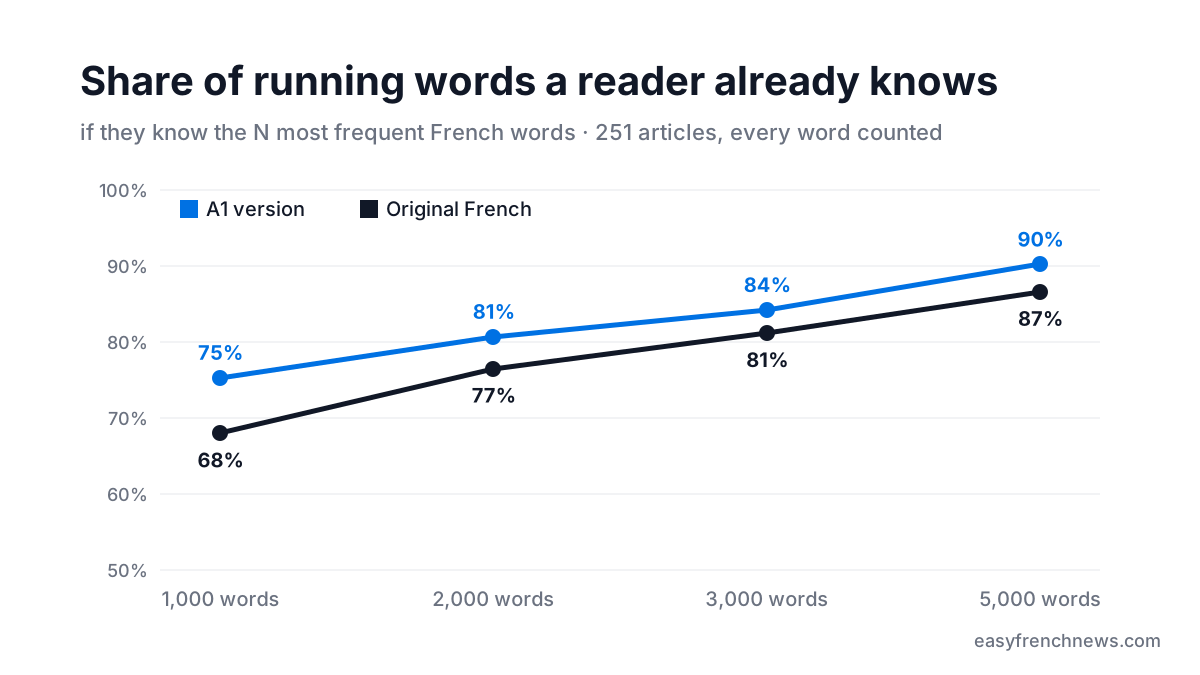
"How many words do I need to read French newspapers?" It's one of the most common questions learners ask, and the answers online range from 2,000 to 20,000. We can't settle it for every text, but we can answer it for one corpus we know well: every article we've published. We counted every word in 251 articles, at every level.
The numbers
| If you know the most frequent… | …you know this share of the words in an original article | …and in an A1 brief |
|---|---|---|
| 1,000 words | 68% | 75% |
| 2,000 words | 77% | 81% |
| 3,000 words | 81% | 84% |
| 5,000 words | 87% | 90% |
"Running words" means every word as it appears, so le counts each time it occurs. That's what matters when you read: how often you hit a word you don't know.
Why 87% doesn't feel like 87%
Knowing 87% of the words sounds like a lot. But it means about one unknown word in every eight, roughly three per sentence in native news, where the average sentence runs to 24 words. That's hard going.
Reading researchers have tried to pin down the threshold. Batia Laufer's work suggested about 95% coverage for reasonable comprehension. Hu and Nation's study put comfortable, unassisted reading of fiction at around 98%, one unknown word in fifty. Those figures come from English, but the principle carries over: the last few percent make the difference between decoding and reading.
Two things close the gap in practice:
- Names and numbers. Our counts treat Madrid, 2026 and CNIC as "unknown" because no frequency list includes them. In a real article they rarely block you. Part of the missing 13% is this.
- Topic words. A science article will repeat chercheurs, étude and résultats many times. Learn them once and that article's coverage jumps.
So, how many words?
An honest answer, from these numbers:
- About 1,000 words gets you the skeleton of any article: who did what. That's A1–A2 territory, and it's why short briefs work at that stage.
- About 3,000 words plus the news vocabulary (a few hundred words like gouvernement, hausse, selon, enquête) makes B1 texts comfortable and lets you follow an original with lookups.
- 5,000 words and more, plus familiarity with each topic, gets you to reading native news without a dictionary in your hand. That's the B2 band, around NCLC 7.
The vocabulary differs by only a few points between our A1 briefs and the originals. The bigger change is sentence length, which we measured separately. Vocabulary gets you in the door; long sentences are the next room.
How to build those words from the news
Prioritise frequency, then topic
When you meet an unknown word, ask: will I see this again? Toutefois (however) will come back every week. A rare species of orchid won't. Save the first kind.
Read in topic runs
Read three or four articles on the same topic in a row, for example three science stories. Topic words repeat across them, and repetition is what makes words stick. On Easy French News you can browse by topic for exactly this.
Review what you save
Saving a word does nothing on its own. Reviewing it at growing intervals is what moves it into long-term memory. We explain the method in how to remember the words you meet in the news.
Check your coverage, not your word count
Word counts are hard to estimate. Coverage is easy to feel: if you're stopping more than once a sentence, the text is above your level. Choose a level where you stop a few times a paragraph, and move up as that becomes rare. The site's four levels are built to make that step manageable.